

Racist Incident Helpline – 
(1-833-457-5463)
Monday to Friday, 9 am to 5 pm (PT).
Contact 1-833-457-5463
For the Racist Incident Helpline and more information, click: here
It is free, confidential and available in over 240 languages.
The Racist Incident Helpline is not intended to replace emergency services. If you are in immediate crisis or danger, call 911.
When you dial 1-833-457-5463, you’ll be connected directly with a staff member who has completed trauma response and cultural sensitivity training. The The operator can:
What Happens When You Call?
- Listen to your experience,
- Provide information about local support services,
- Direct you on next steps based on your comfort level, and
- With your consent, refer you to the services that best match your needs.
Assistance is available in over 240 languages, so let the person who answers your call know your preferred language.
Our Community Protocol – response to Prejudice and Hate
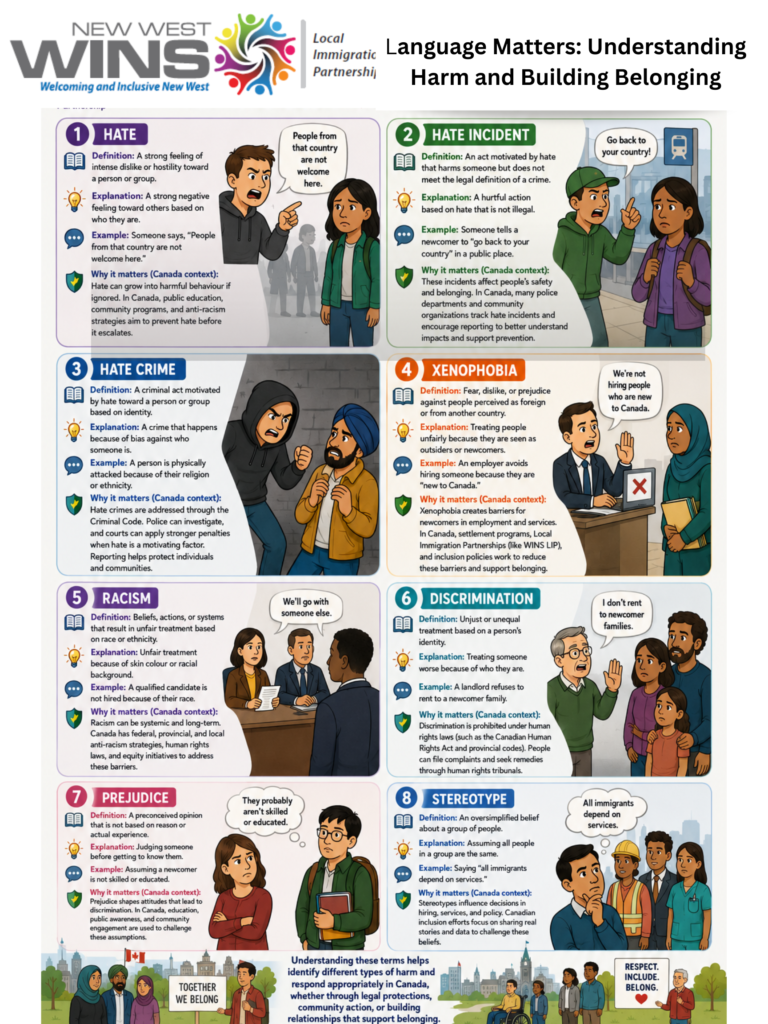
Language Matters: Understanding Harm and Building Belonging
- 1. Hate
Definition:
A strong feeling of intense dislike or hostility toward a person or group.
Explanation:
A strong negative feeling toward others based on who they are.
Example:
Someone says, “People from that country are not welcome here.”
Why it matters (Canada context):
Hate can grow into harmful behaviour if ignored. In Canada, public education, community programs, and anti-racism strategies aim to prevent hate before it escalates.
2. Hate Incident
Definition:
An act motivated by hate that harms someone but does not meet the legal definition of a crime.
Explanation:
A hurtful action based on hate that is not illegal.
Example:
Someone tells a newcomer to “go back to your country” in a public place.
Why it matters (Canada context):
These incidents affect people’s safety and belonging. In Canada, many police departments and community organizations track hate incidents and encourage reporting to better understand impacts and support prevention.
3. Hate Crime
Definition:
A criminal act motivated by hate toward a person or group based on identity.
Explanation:
A crime that happens because of bias against who someone is.
Example:
A person is physically attacked because of their religion or ethnicity.
Why it matters (Canada context):
Hate crimes are addressed through the Criminal Code. Police can investigate, and courts can apply stronger penalties when hate is a motivating factor. Reporting helps protect individuals and communities.
4. Xenophobia
Definition:
Fear, dislike, or prejudice against people perceived as foreign or from another country.
Explanation:
Treating people unfairly because they are seen as outsiders or newcomers.
Example:
An employer avoids hiring someone because they are “new to Canada.”
Why it matters (Canada context):
Xenophobia creates barriers for newcomers in employment and services. In Canada, settlement programs, Local Immigration Partnerships (like WINS LIP), and inclusion policies work to reduce these barriers and support belonging.
5. Racism
Definition:
Beliefs, actions, or systems that result in unfair treatment based on race or ethnicity.
Explanation:
Unfair treatment because of skin colour or racial background.
Example:
A qualified candidate is not hired because of their race.
Why it matters (Canada context):
Racism can be systemic and long-term. Canada has federal, provincial, and local anti-racism strategies, human rights laws, and equity initiatives to address these barriers.
6. Discrimination
Definition:
Unjust or unequal treatment based on a person’s identity.
Explanation:
Treating someone worse because of who they are.
Example:
A landlord refuses to rent to a newcomer family.
Why it matters (Canada context):
Discrimination is prohibited under human rights laws (such as the Canadian Human Rights Act and provincial codes). People can file complaints and seek remedies through human rights tribunals.
7. Prejudice
Definition:
A preconceived opinion that is not based on reason or actual experience.
Explanation:
Judging someone before getting to know them.
Example:
Assuming a newcomer is not skilled or educated.
Why it matters (Canada context):
Prejudice shapes attitudes that lead to discrimination. In Canada, education, public awareness, and community engagement are used to challenge these assumptions.
8. Stereotype
Definition:
An oversimplified belief about a group of people.
Explanation:
Assuming all people in a group are the same.
Example:
Saying “all immigrants depend on services.”
Why it matters (Canada context):
Stereotypes influence decisions in hiring, services, and policy. Canadian inclusion efforts focus on sharing real stories and data to challenge these beliefs.
Understanding these terms helps identify different types of harm and respond appropriately in Canada, whether through legal protections, community action, or building relationships that support belonging.
Hilarious Tales of Cultural Confusion in New Westminster
By Janet Goosney
Hilarious Tales of Cultural Confusion in New Westminster
By Janet Goosney

There’s a delightful saying in Korea: “You can’t spit on a smiling face!” Imagine trying to stay mad at someone who’s grinning at you like they just won the lottery. But this charming saying once caused a young student in Canada a bit of trouble. She smiled, as she had been taught, while being scolded by her teacher for a minor mistake. The teacher, not understanding, thought she was smirking. Talk about a cultural facepalm
WINS-LIP Collection of Cultural Differences from the Community
Shared by WINS members,
Enriching Experiences
Cultural differences can turn classrooms, workplaces, places of worship, and friendships into vibrant, colorful mosaics. But sometimes, these differences can be misinterpreted or misunderstood, like trying to read a book upside down. Hidden values and worldviews can be tricky to navigate. Think of differing concepts of time (is five minutes late really late?), personal space (are we hugging or high-fiving?), eye contact (staring contest or respectful glance?), or attitudes towards aging and death (celebration or solemnity?).
We can’t know all of them, but we can show understanding and respect. Here are a few cultural expectations in Canadian culture that might help newcomers avoid stepping on a few toes:
- In Interviews: It’s crucial to be on time for an interview. Arrive five minutes early and be ready to talk about yourself like you’re the next superhero.
- In the Office: The Canadian workplace is more casual than in many countries, but it still has its own hierarchy. Respectful boundaries between management and staff are as clear as a freshly cleaned window. Dress codes might be more casual, but don’t show up in your pajamas – check with your colleagues first.
- The School Setting: Teachers should remember that newcomer students might be used to very different teaching and learning styles. Encourage students to ask questions if they’re unsure. Parents should chat with teachers if misunderstandings occur – think of it as a friendly neighborhood meeting.
Take time to ask about differences. No one needs to change; just show understanding and respect. These conversations can be interesting, meaningful, and even hilarious. Now, let’s dive into some anecdotes that will have you laughing out loud!
The Coat Tug-of-War: I was born in England but grew up in Canada. Years ago, around the time of Glasnost and Perestroika in the Soviet Union, I visited the country. It was Christmas time and colder than a snowman’s nose – something like 30 below. As I disembarked from the plane and walked across the tarmac, I was bone-numbingly cold. We went inside and made our way to a restaurant. As I entered, the staff wanted to take my coat. I was so cold I couldn’t let go of it. Well, he pulled, I tugged back. He pulled again. I spoke one of the only words I knew – over and over – “niet, niet, niet.” What a scene we made! I kept the coat much to his chagrin.After a day or so, I realized that keeping your coat on was very disrespectful in that country at that time. While I thought he was being inconsiderate of my coldness, he was really trying to help me be a respectful traveler. At every gallery, museum, or other institution I visited, you took your coat off and hung it in a coat room. Always! My coat was never touched, but there were occasions when someone would be waiting for me to return to my coat so they could barter with me. I kept my coat but bartered away my jeans.
The Pump Predicament: When we first moved to Canada, my mother wanted to buy a pair of sneakers for my 13-year-old brother, Stephen, for physical education class in school. We always called sneakers ‘pumps’. My mother kept asking the shop clerk for pumps and pointed to Stephen. She knew the sizes differed in this country but not the name. The clerk kept shaking her head, “No, no, not for a boy.” But finally, as my mother insisted, she brought out a pair of black high heel shoes – pumps in Canada. My mum actually became long-time friends with that clerk; they stayed connected all their lives, and it all began with a funny misunderstanding.
The Accent Amusement: Just a little thing, but when we moved to a rural community at the far east of Canada, on my first day of school, I replied to a question my teacher asked me. She laughed and said, “Your accent is so funny, stand up and say that again so everyone can hear.” I know that’s not exactly a cultural difference, but it definitely showed a lack of understanding towards a ten-year-old.The Hot Dog Horror: A family member recently arrived with her parents and younger brother from China. They went to a local restaurant and read ‘hot dogs’ on the menu. The brother, who was much more adventurous, asked for one to the terror of his sister’s imagination. When the hot dog arrived, the little brother was terrified! He was confused and wasn’t sure what he got. They did not realize what a hot dog really was until a couple of years later at school.
Cultural differences are like the many threads in a beautiful tapestry. By embracing these differences with open hearts and minds, we create a stronger, more vibrant community. Let’s celebrate the diversity that makes New Westminster a place where everyone belongs – and where laughter is always welcome!
Trash Your Prejudice. 🗑️
🗑️ Trash Your Prejudice

An Interactive Community Activity
Join WINS LIP for “Trash Your Prejudice”, an engaging and reflective activity designed to promote inclusivity and challenge discrimination in our community. Participants are invited to write down prejudices they’ve encountered or internalized and place them in a symbolic “trash bin,” creating a safe space for reflection, dialogue, and empathy.
This initiative has been part of various community events in New Westminster, including Canada Day celebrations, and encourages residents to actively participate in conversations about diversity, understanding, and belonging.
Contact Us for more details.
This is a anti-racism video I worked on with Lama Mugabo for the City of New Westminster Sanctuary City projected